CJC-1295 and Ipamorelin Without TRT: Leaving Results on the Table?
By Jeremiah Velasquez, FNP-BC, AGACNP-BC
Founder, Steel City HRT & Weight Loss | Board-Certified Family & Acute Care Nurse Practitioner
NPI: 1841894003
CJC-1295 and ipamorelin are growth hormone secretagogues studied for fat loss, improved body composition, and enhanced sleep-stage recovery. When used alongside suboptimal testosterone levels, their effectiveness is significantly blunted. Testosterone and growth hormone share a synergistic relationship through IGF-1 signaling — optimizing both hormones simultaneously produces compounding results that neither achieves alone.
You've probably seen it: guys running CJC-1295 and ipamorelin, doing the protocol right, expecting real transformation — and getting moderate results at best. The peptides are doing their job. The question is whether their hormonal environment is doing its job in return.
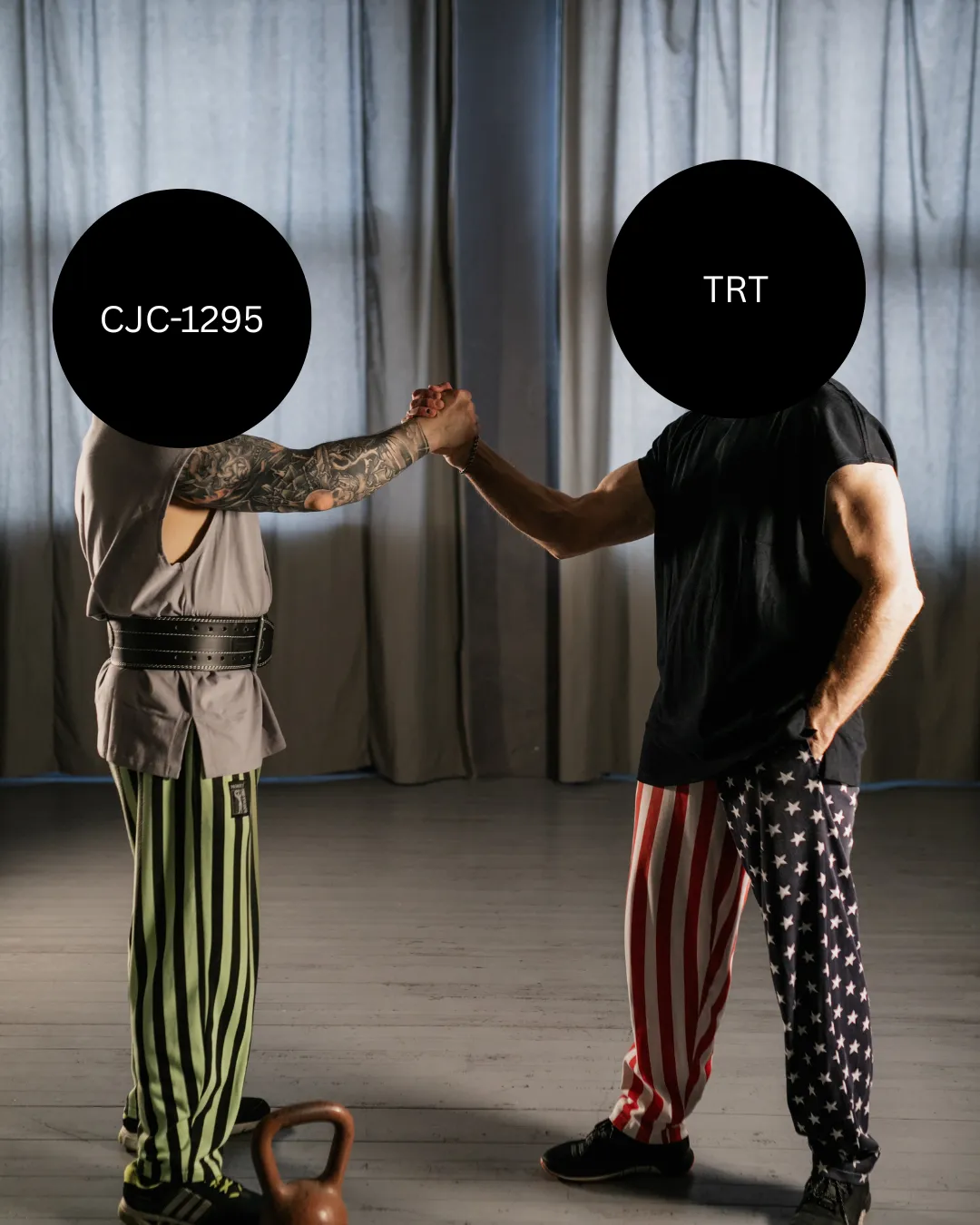
CJC-1295 and ipamorelin are an iconic duo for fat loss and recovery, but using them against a backdrop of low testosterone is like trying to race a sports car on regular unleaded. The engine runs. You just never get out of second gear.
This isn't about adding more peptides. It's not about refining your injection timing or pushing your dose. It's about understanding the physiological system those peptides are working inside — and whether that system is positioned to respond.
If you've been asking yourself whether CJC-1295 and ipamorelin actually work without testosterone optimization, you're asking exactly the right question. The answer changes everything about how you build this stack.
Why Does Testosterone Deficiency Undermine Your CJC-1295 and Ipamorelin Stack?
Your frustration with incomplete results isn't a you problem. It's an information problem. A fractured healthcare system has spent decades treating hormones as isolated variables — testing one panel, prescribing one compound, sending you out the door. Nobody told you these axes talk to each other.
CJC-1295 is a growth hormone-releasing hormone (GHRH) analog — a peptide that signals the pituitary gland to produce and release more growth hormone. Ipamorelin is a growth hormone secretagogue — a compound that mimics ghrelin to amplify that pituitary GH pulse, while specifically avoiding the cortisol and prolactin spikes associated with earlier-generation secretagogues. Together, they create a cleaner, more sustained growth hormone signal than either achieves alone.
But that GH signal doesn't operate in a vacuum. Here's the compounding problem most men don't find out until after months of underwhelming results:
Growth hormone's primary anabolic effect is mediated through IGF-1 — a downstream hormone produced primarily in the liver in response to GH stimulation. IGF-1 is what actually drives lean mass accrual, fat mobilization, and cellular recovery.
Testosterone is a direct driver of IGF-1 expression. When testosterone is low, the liver's sensitivity to GH stimulation is blunted — reducing IGF-1 output even when GH levels are elevated.
Low testosterone undermines nitrogen retention and muscle protein synthesis, the anabolic scaffold that CJC-1295 and ipamorelin are designed to amplify.
Without that foundation, the fat-burning and recovery effects of elevated GH are working with one hand tied behind their back.
You're not failing the protocol. The protocol is failing to tell you what it needs to work.
Key takeaway: Testosterone directly modulates IGF-1 expression, meaning deficiency in testosterone blunts the anabolic and metabolic response to CJC-1295 and ipamorelin — regardless of how well the peptide protocol itself is executed.
How Do Growth Hormone, Testosterone, and IGF-1 Actually Work Together?
Here's what most people don't know: the relationship between growth hormone and testosterone isn't parallel — it's bidirectional and amplifying. They share regulatory axes that determine how effectively either hormone can operate inside your body.
When CJC-1295 and ipamorelin stimulate the pituitary to release GH, that GH travels to the liver and activates IGF-1 production. According to a review published in the Journal of Clinical Endocrinology and Metabolism, testosterone enhances hepatic GH receptor sensitivity — meaning higher testosterone levels increase the liver's responsiveness to GH, producing more IGF-1 per unit of GH secreted. Think of testosterone as the amplifier and growth hormone as the signal. Without the amplifier running at full capacity, you're getting signal. You're not getting volume.
As a board-certified nurse practitioner, Jeremiah Velasquez has worked with men running peptide protocols in isolation who cycled through dosage adjustments looking for results that never fully arrived — only to discover their total testosterone was sitting at 270 ng/dL. That's not a peptide dosing problem. That's a hormonal foundation problem.
According to the Endocrine Society's clinical practice guidelines, optimal testosterone for androgenic function and body composition falls in the 700–1,000 ng/dL range. Most conventional reference ranges accept anything above 300 ng/dL as "normal." That gap — between not deficient and actually optimized — is exactly where your CJC/ipamorelin stack is operating in survival mode instead of performance mode.
Every domain where this stack is supposed to deliver — fat mobilization, lean mass, sleep-stage architecture, recovery time, cognitive drive — is a shared output of GH, IGF-1, and testosterone operating together. Optimize one and neglect the other, and you're budgeting for a full renovation while leaving the foundation cracked.
Key takeaway: According to the Journal of Clinical Endocrinology and Metabolism, testosterone enhances hepatic GH receptor sensitivity — making optimized testosterone the prerequisite for maximum IGF-1 output from a CJC-1295 and ipamorelin protocol.
What Does a Synchronized TRT and Peptide Stack Actually Look Like in Practice?
The math here isn't 2+2=4. When testosterone optimization and a properly designed secretagogue protocol are built together, the results are compounding in a way that neither achieves alone. You get the anabolic scaffold from TRT — nitrogen retention, lean mass accrual, drive — layered with the metabolic acceleration from CJC-1295 and ipamorelin: fat mobilization, GH pulsatility, deep sleep recovery. Those aren't additive benefits. They're synergistic ones.
Effective combined protocol design looks like this:
Baseline labs first — total and free testosterone, IGF-1, LH, FSH, estradiol, and a complete metabolic panel. You cannot design a synchronized stack without knowing what each system is actually doing.
TRT optimization — establishing your testosterone protocol to bring levels into the functional 700–1,000 ng/dL range before any secretagogue is introduced.
Secretagogue layering — once the hormonal environment is stable, CJC-1295 and ipamorelin are introduced to amplify GH pulsatility during the nighttime sleep cycle, where natural GH secretion peaks.
Ongoing monitoring — IGF-1, hematocrit, testosterone levels, and symptom reassessment at regular intervals to keep both systems calibrated without overshoot.
Running the peptides first and asking about testosterone later is backwards. The anabolic environment has to be built. Then you maximize it.
You've got two options. Keep running half a protocol and wonder why the results keep plateauing — or build the hormonal foundation that makes your investment in peptide therapy actually pay off.
Key takeaway: A synchronized TRT and peptide protocol — establishing testosterone optimization first, then layering CJC-1295 and ipamorelin — produces compounding body composition and recovery results that neither therapy achieves independently.
Why Are Men Choosing Steel City HRT & Weight Loss for Synchronized Hormone and Peptide Protocols?
I've been on both sides of that table. I've watched men get excited about peptide therapy, source their compounds without clinical guidance, and run a stack with no hormonal foundation — and I've also seen what happens when TRT and secretagogues are designed together with intention. The difference isn't subtle.
Steel City HRT & Weight Loss is LegitScript-certified — the same compliance standard used by major pharmacy chains to screen telehealth providers for legitimacy and safety. That matters because the peptide market is saturated with Research Use Only (RUO) compounds — substances not manufactured under pharmaceutical-grade controls, with no established human dosing safety data, and sold explicitly as "research chemicals" to circumvent FDA oversight. The downstream risk to the person injecting them is real: unknown purity, inconsistent potency, microbial contamination, and zero clinical recourse when something goes wrong. We love a good neighborhood BBQ, but we generally recommend keeping the DIY projects limited to the patio — not your bloodstream.
Steel City sources exclusively from 503a-licensed compounding pharmacies operating under USP 797 sterility and potency standards. That's not a marketing position. It's the clinical baseline for any peptide protocol worth running.
When you work with Steel City, our medical providers map TRT and secretagogue protocols simultaneously — not as two separate programs bolted together after the fact, but as a single synchronized system designed from the start to amplify each other. Starting with comprehensive labs, followed by a telehealth consult, and ending with individualized therapy delivered directly to your door. We don't write a prescription and send you on your way. We stay in your corner.
Ready to Build a Stack That Actually Delivers?
If you're already running CJC-1295 and ipamorelin — or you've been considering it — the most important question isn't which peptides you're using. It's whether the hormonal environment you're running them in is positioned to respond.
Getting that answer starts with labs, not guesswork. Steel City's telehealth model gives you access to a board-certified provider without waiting rooms, referral backlogs, or providers who've never encountered a GHRH analog. No waiting room. No unanswered questions. Direct access to a clinical team that builds these stacks for a living.
You've got two options: keep running a half-optimized protocol and capping your results before they start — or build the full system and find out what your physiology actually does when everything is working together. Labs, consult, synchronized protocol — that straightforward. It all starts at steelcity-trt.com.
Frequently Asked Questions
Q: What is CJC-1295 and ipamorelin? A: CJC-1295 is a growth hormone-releasing hormone (GHRH) analog that stimulates the pituitary gland to release more growth hormone. Ipamorelin is a growth hormone secretagogue that amplifies that GH pulse while minimizing cortisol and prolactin elevation. Together, these peptides are studied for fat loss, lean mass recovery, improved sleep quality, and body composition optimization under clinical supervision.
Q: Can I use CJC-1295 and ipamorelin without testosterone replacement therapy? A: CJC-1295 and ipamorelin can be prescribed independently, but men with suboptimal testosterone levels typically see significantly blunted results. Testosterone drives IGF-1 expression and provides the anabolic scaffold that growth hormone requires to produce meaningful body composition changes. Without optimized testosterone, the peptide stack operates against a hormonal deficit that limits its full effect.
Q: How does testosterone affect IGF-1 levels? A: Testosterone enhances the liver's sensitivity to growth hormone signaling, increasing IGF-1 production per unit of GH secreted. According to the Journal of Clinical Endocrinology and Metabolism, this bidirectional relationship means suboptimal testosterone directly reduces IGF-1 output — blunting the body composition benefits of CJC-1295 and ipamorelin even when GH levels are elevated by the peptide protocol.
Q: Is it safe to combine testosterone replacement therapy with peptide therapy? A: Combining TRT with CJC-1295 and ipamorelin is an established clinical practice under proper medical supervision. Safety depends on baseline labs, appropriate dosing, ongoing monitoring of IGF-1, hematocrit, and testosterone levels, and sourcing peptides through licensed 503a compounding pharmacies operating under USP 797 sterility standards — not Research Use Only (RUO) compounds, which carry significant safety risks.
Q: What is the difference between 503a-compounded peptides and RUO peptides? A: 503a-compounded peptides are prepared by licensed pharmacies under FDA oversight and USP 797 sterility standards, verified for purity and concentration, and intended for human clinical use. RUO (Research Use Only) peptides are not manufactured to human-grade pharmaceutical standards, carry no established human dosing data, and are not FDA-approved for human administration. The contamination and unknown potency risks associated with RUO sourcing are not clinically acceptable.
Q: How does Steel City HRT & Weight Loss design TRT and peptide protocols together? A: Steel City HRT & Weight Loss is a LegitScript-certified telehealth clinic that designs TRT and peptide protocols simultaneously — beginning with comprehensive bloodwork including testosterone, IGF-1, and metabolic markers. Medical providers map both protocols as a single synchronized system. All peptides are sourced exclusively through 503a-licensed compounding pharmacies. The process starts with labs, moves to a telehealth consult, and ends with individualized therapy delivered to your door.
This content is for informational purposes only and does not constitute medical advice. Consult a licensed provider before beginning any hormone or weight loss therapy. Jeremiah Velasquez, FNP-BC, AGACNP-BC, is a licensed nurse practitioner. Steel City HRT & Weight Loss is a LegitScript-certified telehealth clinic.